Research
Decoding the dialogue
between immunity
and the gut.
We study the rules that connect microbial recognition, immune memory and tissue environments to intestinal health.
Immune–microbe interactions
What makes a microbe
a target—or a partner?
The intestine encounters a remarkable range of microbial proteins, sugars and lipids. Yet immune responses to these molecules can protect the barrier, coexist with microbes or drive inflammation. What determines the outcome?
Our vitamin D study linked treatment to changes in antibody-coated bacteria and immune programs associated with tolerance. It motivates a deeper question: which microbial targets and receptor features underlie these changes?
We combine IgA- and IgG-sorted microbiome profiling with B- and T-cell receptor sequencing. Our program, REMIT: Learning the Immune Repertoire–Microbiome Code of Intestinal Immune Tolerance, asks whether the chemistry of an antibody motif predicts recognition across receptor contexts. Reconstructed antibodies, defined substitutions and tissue assays will test these predictions. T cells are studied through their distinct recognition of microbial peptides presented by HLA molecules.
Starting point: published study (opens in a new tab)Adaptive immune states
How does immune history
shape inflammation?
Every expanded T-cell clone and maturing antibody lineage carries a record of immune experience. Understanding how that history relates to current cell behavior could reveal why inflammation persists—and why it differs between people.
Our single-cell blood atlas across 249 participants connects receptor features with B- and T-cell programs in inflammatory bowel disease. It links clonal expansion and antibody maturation to coordinated immune states.
We integrate single-cell transcriptomes, paired receptor sequences and repertoire architecture to ask which relationships extend from blood into the intestine. Longitudinal patient samples help us distinguish persistent immune histories from changing disease states and treatment responses.
Starting point: preprint (opens in a new tab)Tissue environments
How does a tissue
instruct an immune cell?
An immune cell’s behavior depends on the neighborhood it enters. Intestinal fibroblasts help organize the tissue, but the signals they provide can also influence inflammatory responses.
Our recent ulcerative colitis preprint combines human tissue profiling, spatial imaging, cell cultures and mouse studies to examine stromal regulation of neutrophil phenotypes, including the role of α5β1.
We ask which local signals sustain damaging inflammation and which support repair. Single-cell and spatial measurements locate candidate interactions. Coculture and experimental models test their effects, linking the tissue environment to mechanisms of persistent disease and therapy failure.
Starting point: preprint (opens in a new tab)Computational immunology
Can we learn rules
that hold beyond one dataset?
Immune repertoires contain millions of sequences. Finding a pattern is only a starting point. The challenge is to identify interpretable relationships that persist across patients and withstand experimental tests.
Our collaborative immuneML work develops reproducible approaches for exploring adaptive immune receptors, including clustering, generative models and comparisons between computational methods.
We connect receptor chemistry, cell states and microbiome measurements to build and test biological predictions. Models evaluated in independent patient groups help prioritize mechanisms. Controlled receptor experiments then ask whether changing a predicted feature changes recognition—turning associations into testable explanations.
Starting point: preprint (opens in a new tab)Our approach
From patients to mechanisms.
And back to the next question.
Four connected approaches bring patient samples, cellular measurements, microbiome studies and experimental predictions together.
Longitudinal IBD biobanking
Our program aims to build a collaborative resource linking blood, stool, intestinal tissue and immune cells collected over time. Connecting these samples with disease course and treatment response will help us investigate how inflammation begins, persists and changes across patients.
- Blood, stool and tissue
- Longitudinal sampling
- Collaborative biobanking
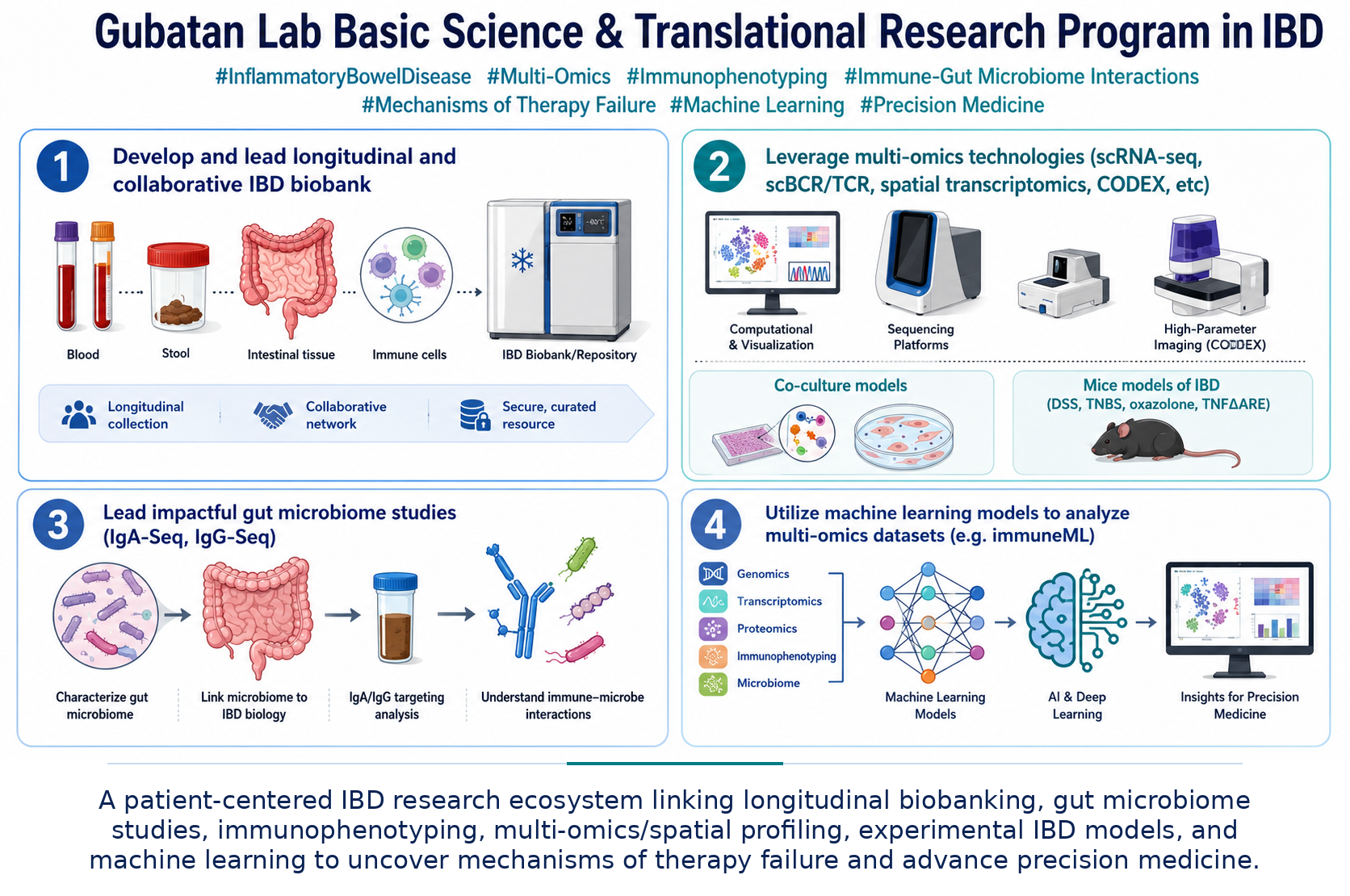
Single-cell and spatial biology
We combine single-cell gene expression, B- and T-cell receptor profiling, and spatial measurements to connect immune cell states with their tissue environments. Coculture systems and experimental models help test candidate interactions and investigate mechanisms of persistent inflammation and therapy failure.
- Single-cell RNA and receptors
- Spatial profiling and imaging
- Functional experiments
Immune–microbiome interactions
We study how the immune system recognizes the gut microbiome using IgA- and IgG-sorted microbial profiling. Linking antibody-coated microbes with receptor features and experimental binding studies helps us investigate which interactions support intestinal tolerance and which may contribute to inflammation.
- IgA-seq and IgG-seq
- Microbiome profiling
- Receptor and binding studies
Machine learning and experimental prediction
We integrate immune receptor, cell-state and microbiome measurements to identify patterns that can be tested across patients and in experiments. Our collaborative immuneML work supports reproducible analysis, while independent validation and controlled receptor experiments help turn computational predictions into biological questions.
- Integrated multi-omics
- Reproducible machine learning
- Independent validation